Years ago, while working in merchandising at Victoria’s Secret PINK, I was part of a team that built and implemented a nine-day speed model—taking product from concept to store in just nine days.
We knew that we were onto a trend with PINK yoga and wanted to capitalize on the success. If a trend emerged, an item started taking off, or we saw an opportunity in the business, we had a way to act on it while the opportunity was still relevant.
That changed the way we could manage the business. We could react to real demand, test before making a bigger bet, chase what worked and reduce some of the inventory risk that comes with trying to predict what the customer will want months in advance.
When we started designing the retail speed to market model, there were so many things to consider: technology, factories, samples, people, meetings, logistics, etc. It was tough to wrap our minds around it all. Ultimately, building that model taught me something that has shaped how I think about speed ever since: The factories were ready. We weren’t.
We went into it assuming that achieving that kind of speed would largely be a manufacturing challenge. Instead, we discovered that our manufacturing partners could be incredibly flexible. Some of the biggest barriers to speed were sitting inside us as the retailer: in our processes, our decision-making, our ways of working and our assumptions about what had to happen before our manufacturing partners could get to work.
We’ve written before about the broader lessons in speed, including why we think speed has fallen by the wayside in many places. But there’s another part of the speed conversation that deserves just as much attention: The relationship between the brand and the manufacturer.

What Are We Really Selecting For?
Retailers know how to evaluate manufacturing capability: Cost. Quality. Capacity. Lead time.
Those things matter. They always will. A manufacturer has to be able to make the product, meet the quality standard, support the volume, deliver within the required timeline and do it at a cost that works for the business. But those criteria primarily tell us whether a manufacturer can do the work. They tell us much less about what it will be like to do the work together.
What happens when customer demand changes? Or when the forecast is wrong? When a product suddenly takes off? When a deadline moves? Or when the original request simply isn’t possible?
Those are the moments when speed actually gets tested, and they require something beyond capability. We need to get better at recognizing those qualities when we select manufacturing partners—not instead of cost, quality, capacity and lead time—but alongside them.
Because capability may get a manufacturer onto the list, but mindset determines what becomes possible once they’re there.
Speed Starts With Context
One of the biggest challenges in brand-manufacturer relationships is that both sides can be having the same conversation while solving completely different problems.
Retailers are thinking about the customer, inventory, margin and trend. Manufacturers are thinking about capacity, efficiency, quality and consistency. Neither side is wrong. They simply have different context.
For example:
- A retailer says, “We need flexibility.”
- A manufacturer may hear, They don’t know what they want.
- But what the retailer may actually mean is, Customer demand is uncertain, and we’re trying to reduce our inventory risk.
Now let’s reverse it:
- A manufacturer says, “We need another week.”
- The retailer may hear, They’re slow.
- But what the manufacturer may actually mean is, We’re protecting quality and trying to prevent a bigger problem downstream.
This is what we call The Great Translation™ at Thread: helping both sides understand the context behind the decisions each side makes. The words aren’t necessarily the problem. What’s often missing is the why behind them. Telling a partner what you need gives them an instruction. Helping them understand why you need it gives them the opportunity to bring their expertise to the problem.
And that works both ways.
When manufacturers understand the retailer’s customer, commercial objectives and risk, they can begin offering solutions with that customer in mind rather than simply executing a request.
When retailers understand manufacturing realities, they start making more informed requests. They ask better questions. They understand the tradeoffs. And they begin to see possibilities they may not have known existed.
Over time, something important happens: that shared understanding builds expertise on both sides. The retailer learns more about how things can be made and what is possible. The manufacturer learns more about the customer and the commercial decisions driving the business. The conversations get better. The solutions get better. And the decisions get better.
Great partnerships don’t just exchange information. They exchange context.
Start Looking for the Speed Signals
So how will you know what someone will be like to work with? If capability tells us whether a manufacturer can do the work, we also need ways to recognize how a potential partner thinks and works.
At Thread, we think about five behaviors as Speed Signals:
- Curiosity. Do they seek to understand the business before jumping to a solution? The best questions aren’t only about specifications. They’re about the customer, the calendar, the business objective and the risk.
- Transparency. Are constraints surfaced early, when there is still time to solve for them? Transparency isn’t about never having a problem. It’s about making sure the other side isn’t surprised by it.
- Commercial Thinking. Can the conversation move beyond cost per unit to the broader economics of the decision—margin, sell-through, inventory risk and the cost of different tradeoffs?
- Problem Solving. When something can’t be done exactly as requested, does the conversation stop at “no,” or does it move immediately to what could be done?
- Adaptability. Can the partner change how they work as the customer, business and marketplace change?
These aren’t “soft” attributes sitting outside the speed model. They are part of what makes speed possible.
Creating speed doesn’t mean asking every team, factory and system to simply move faster. It means intentionally designing the business so it can respond when speed matters: how decisions get made, where flexibility lives, how teams work across functions, when partners are brought into the conversation and how technology supports the work.
The goal isn’t to make everything fast. It’s to know where speed creates value and how to activate it when it does.
Partnership Has to Mean Something
The word partnership gets used very loosely in business.
We call manufacturers our strategic partners while beating them up for cost. We ask them to absorb risk, accommodate late changes, solve problems and remain endlessly flexible. Then we call it partnership.
But a true partnership is a two-way commitment.
Our nine-day speed model didn’t work simply because we had extraordinary factories. It worked because we developed extraordinary partnerships.
We gave them context. They gave us solutions. We challenged each other. We trusted each other. And, importantly, we learned from each other. That learning made both sides better.
Our manufacturing partners became more knowledgeable about our customer and our business. We became more knowledgeable about their capabilities and what was possible. We could ask better questions. They could anticipate what we might need. And together, we could make better decisions faster.
That is very different from sending a purchase order and expecting execution. A transaction ends with a purchase order. A partnership begins there.
What This Means for Brand-Manufacturer Partnerships
So, what does all of this mean for brands and manufacturers trying to create greater speed? It comes down to three things:
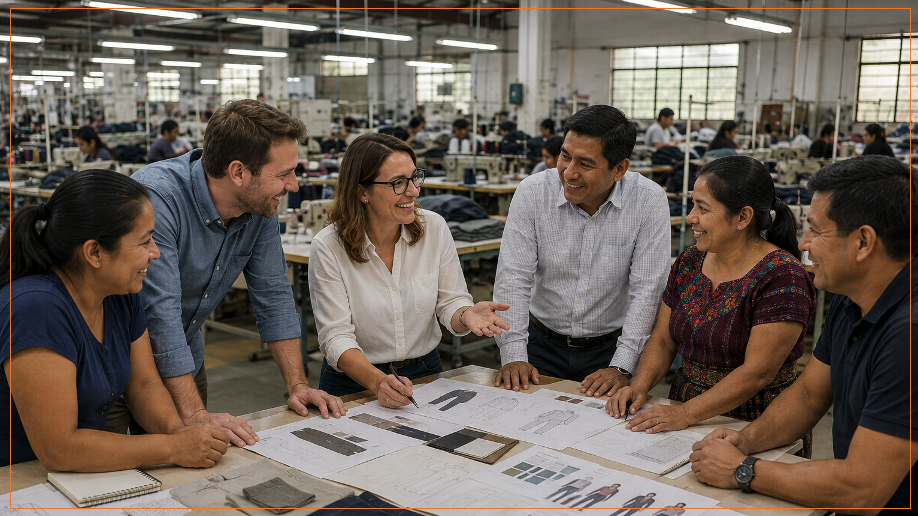
- Share the context. Give each other the why, not simply the request.
- Bridge the translation gap. Get underneath what is being said and understand what the other side is actually trying to accomplish.
- Look for the signals. Pay attention not only to what a potential partner can make, but to how they think, communicate, adapt and solve problems.
Cost, quality, capacity and lead time will always matter. But if we want to build supply chains that can respond faster to the customer, we have to expand what we value in the relationships behind them.
We need manufacturing partners with the capability to deliver and the mindset to collaborate, challenge, adapt and solve alongside us. And manufacturers need brands willing to provide the context, transparency and trust that allow them to do it.
That’s what great partnership looks like.
Because ultimately, speed isn’t something a retailer demands or a manufacturer delivers. It’s something great partners create together.
Ready to learn more?
At Thread Advisory Group, we’re on a mission to radically change how retailers approach go-to-market and speed. Thread Speed™ is how we’re turning that belief into a new way of operating, one that builds speed into the business instead of chasing it after the fact.
Connect with us or learn more at Thread Advisory Group.
If this post somehow made it to your inbox and you’d like to receive more of them, subscribe to our newsletter here: ThreadLines™

This blog was written by Anna Kenney, Managing Partner and Co-Founder of Thread Advisory Group. Anna delivered the keynote at the VESTEX Strategic Sourcing Forum in Guatemala on this same topic.
A merchant at heart, Anna led the Instant Yoga program at Victoria’s Secret PINK, where she helped build one of the fastest retail speed to market models of its time. With nearly 20 years of experience across merchandising, operations, and consulting, she now partners with retail organizations to align strategy, product, and operating models from strategy to solution.















TAG - You're It!