
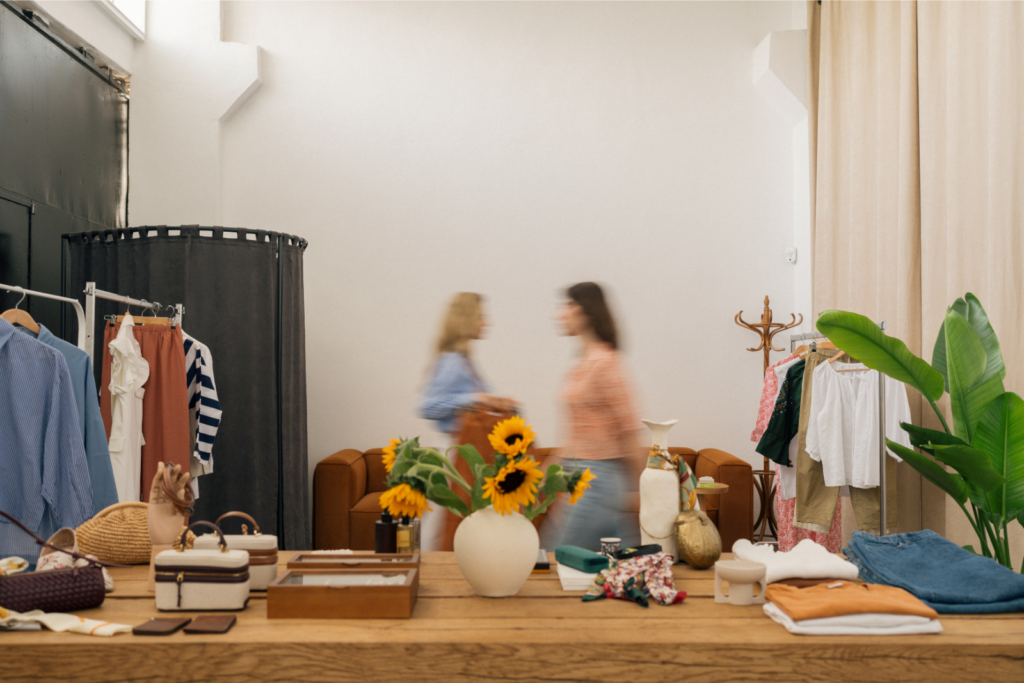
Retailers are spending millions creating experiences designed to drive traffic and increase engagement. They’re adding cafés and bars, hosting classes and workshops, launching community events, and building immersive brand activations.
They’re creating spaces where customers can gather, learn, and connect.
The results can be impressive—from increased traffic and longer dwell times to stronger customer loyalty and social engagement.
But as experiential retail continues to evolve, many retailers are discovering a hard truth:
Building the experience is the easy part. Operating it is the challenge.
Because experiential retail isn’t simply a store design strategy.
It’s an operating model.
And increasingly, that operating model extends well beyond the four walls of the store.

Bad Birdie’s Bad Force One Frostbite Camo Sprinter is a great example. The mobile store takes the brand on the road with exclusive gear, photo opportunities, golf-themed games, and pop-ups at select tour stops and community events.
But think about what has to happen behind that experience: inventory, staffing, training, scheduling, transportation, event execution, technology, customer engagement, and brand consistency—all moving from location to location.
The customer sees the experience. The operating model is what makes it possible.

The Experience Gap
Naturally, most retailers begin their experiential journey by focusing on the customer.
What will customers want?
How can we drive traffic?
What will create buzz?
Which experiences will customers want to share on social media?
Of course these questions matter. But there’s a bigger one:
Can the organization consistently deliver the experience it has designed?
Because the difference between a great concept and a sustainable strategy often comes down to execution.
And execution is rarely a design problem.
It’s an organizational one.
The Store Manager Role Has Changed
Historically, store leaders were responsible for driving sales, managing inventory, coaching associates, and executing operational processes. Experiential retail adds an entirely new layer of responsibility.
Today, a store manager may also be expected to:
- Host community events
- Facilitate workshops
- Build local partnerships
- Manage brand ambassadors
- Coordinate experiences
- Create social media moments
- Foster customer communities
That’s a fundamentally different role.
The skills required to run a high-performing store aren’t necessarily the same skills required to build and sustain a community. Retailers that ignore this reality often find themselves with beautiful experiences and overwhelmed store teams.

The Labor Model Challenge
One of the most overlooked aspects of experiential retail is labor.
Traditional labor models were built around transactions. Experiential retail introduces new demands.
Classes need facilitators, events require planning and execution, community experiences require relationship building, and hospitality concepts require service standards.
Ultimately, someone has to own these activities.
Yet many retailers attempt to layer these responsibilities onto already stretched store teams without changing expectations, staffing models, or workload assumptions.
The result is predictable.
The experience becomes inconsistent. And inconsistent experiences quickly lose their value.
What Gets Measured Gets Managed
Most retail KPIs were designed for transactional environments.
Sales per square foot.
Conversion.
Units per transaction.
Average order value.
Inventory productivity.
While these metrics remain important, they don’t fully capture the value of experiential retail.
As the role of the store evolves, the way retailers measure success must evolve with it.
For example, if the goal is community, what metrics matter most?
For education, what does success look like?
And when it comes to loyalty, what leading indicators matter?
This shift is challenging retailers to develop new measures of success that complement traditional financial metrics. The organizations that get this right will gain a significant advantage.
After all, teams naturally focus on what leadership measures.

Who Owns the Experience?
Perhaps the most interesting question of all is organizational.
Who owns experiential retail?
Is it marketing? Store Operations? Merchandising? Brand? Customer Experience? Community?
The answer varies by organization. And increasingly, leading retailers are experimenting with new leadership structures.
Some have created Chief Experience Officer roles. Others have elevated Community, Membership, or Brand functions. Gap recently introduced a Chief Entertainment Officer role to support its emerging “Fashiontainment” strategy.
Taken together, these changes signal something important.
Experiential retail is becoming too important to be owned by a single department.
The experience spans the entire customer journey.
Which means organizational silos become a liability.
The Capability Retailers Need Most
When retailers discuss experiential retail, the conversation often centers on design, technology, and innovation.
Yet what matters most may be much simpler: people—and how they are led.
Experiences are delivered by people.
Communities are built by people.
Relationships are built by people.
No amount of technology can replace a store team that knows how to engage customers, create connections, facilitate learning, and build trust. The retailers that succeed will invest as heavily in capability building as they do in store design.
Because a great experience is only as strong as the people delivering it.

The Next Evolution of Retail
Experiential retail is not a trend. It is a response to a fundamental shift in consumer behavior.
Customers no longer visit stores simply to acquire products.
They visit for inspiration.
Connection.
Learning
Entertainment.
Belonging.
The retailers that thrive in this environment will understand that creating experiences is only the beginning. The real challenge is building an organization capable of delivering those experiences consistently, authentically, and at scale.
That’s why experiential retail isn’t a store design strategy.
It’s an operating model.
The retailers that recognize that distinction will be the ones that turn experiences into sustainable competitive advantage.
Ready to Learn More?
At Thread, we help retailers build experiential retail operating models that align people, processes, and technology to enable customer experiences that are consistent, scalable, and built to last.
Connect with us or learn more at Thread Advisory Group.

Carrie Habel is the author of this blog and Co-Founder and Managing Partner of Thread Advisory Group. With more than 30 years of experience across retail leadership, operations, learning, and transformation, Carrie partners with organizations to turn strategy into solutions that work in the real world.
She believes the strongest retail organizations are built by aligning people, processes, and priorities—and keeping human connection at the center.











TAG - You're It!